Male pattern baldness, also known as androgenetic alopecia, is the most common type of hair loss in men. It is estimated that over 50% of men will experience some degree of hair thinning by the age of 50.
The Norwood-Hamilton classification system is the most widely used scale for defining the stages and patterns of male pattern baldness.
What is the Norwood-Hamilton Scale?
The Norwood-Hamilton scale was first published in 1975 by Dr. O’Tar Norwood. It classifies male pattern baldness into seven stages, with each stage representing a progressively higher degree of hair loss.
The scale assigns a grade from I (minimal hair loss) to VII (extensive hair loss) based on the location and extent of thinning.
Hamilton later modified Norwood’s original scale by adding a Type A variant to describe diffuse thinning that often precedes more extensive hair loss. The scale is now commonly referred to as the Norwood-Hamilton scale.
Stages of the Norwood-Hamilton Scale
The classification has seven levels, ranging from minimal alopecia to baldness (total hair loss).
Stage 1
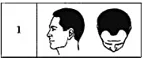
There is minimal hair loss at this point. The hairline may have slightly receded but there is no obvious thinning.
Stage 2
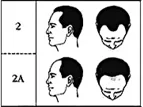
The hairline clearly begins to recede and shows an “M” shape. The temporal recession is more pronounced compared to Stage I but it can be considered balding.
Stage 3
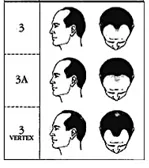
The hairline recedes further and forms a deeper “M” shape. There is moderate thinning around the crown area but no obvious bald spot yet.
In this stage, it can either go to the 3A stage which shows the “M” shape disappearing because of the further receding hairline or it can go to vertex stage where a bald spot appears on the crown.
At this stage, it can’t still be considered balding. However, from this stage, every higher level on the scale can be considered balding
Read Also: AT WHAT AGE DOES BALDNESS START?
Stage 4
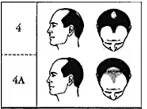
The hairline recedes to the point where it almost forms an “O” shape. A bald spot also develops on the crown which is still separated from the receding frontal hairline.
Stage 5
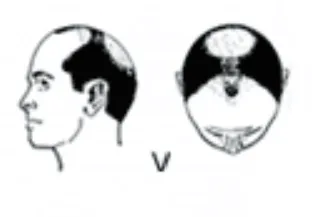
The hairline has receded farther back, intensifying the “O” shape. The bald spot on the crown broadens and joins the receding frontal hairline.
Stage 6
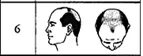
This stage depicts more extensive hair loss. The hairline recedes even farther back and bald spots occupy a wide area on the crown. Remnant strands of hair separate the receding frontal line and crown.
Stage 7
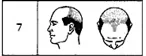
There is extensive hair loss on the crown coupled with a severely receded hairline. At this stage, only a horseshoe ring of hair remains on the sides and back of the head. It is the last stage and is considered total baldness at this point.
Using the Norwood-Hamilton Scale
The Norwood-Hamilton scale serves as a useful tool for both patients and physicians to assess the progression of male pattern baldness.
Identifying the stage can help determine the appropriate treatment options, whether it may be medications, hair transplants or other hair restoration procedures.
Being familiar with the Norwood-Hamilton scale helps patients understand the extent of their hair loss and what to expect in the future.
The Seven Stages at a Glance
| Stage | What it looks like |
|---|---|
| 1 | No real recession. The youthful hairline is intact. |
| 2 | Slight recession at the temples. This is the mature hairline most men reach. |
| 3 | Deeper temple recession in an M shape. The first clearly balding stage. |
| 3 Vertex | Hairline still at stage 3, but a bald spot now opens at the crown. |
| 4 | Larger temple loss plus a defined crown patch, separated by a band of hair. |
| 5 | The band between front and crown narrows and thins. |
| 6 | The bridge of hair is gone. Front and crown bald areas join. |
| 7 | Most advanced. Only a horseshoe of hair around the back and sides remains. |
The Norwood A Variant
There is a less common pattern doctors call the Norwood Class A. Instead of the crown and hairline thinning separately and meeting later, the whole hairline marches straight back from front to crown in one front-to-back wave. It accounts for a small share of cases, tends to start later, and matters for hair transplant planning because the donor area behaves differently.
What Each Stage Means for Treatment
- Stages 1 to 2: Nothing required. If you have a family history and want to be proactive, this is the best time to start preventive treatment.
- Stages 3 to 4: The sweet spot for medication. Minoxidil and finasteride work best at holding onto hair you still have, so earlier is better.
- Stages 5 to 6: Medication can still help the remaining hair, and these stages are common candidates for hair transplants, since the donor hair on the back and sides is usually stable.
- Stage 7: Limited donor hair makes large transplants harder. Many men at this stage choose a clean shaved look, scalp micropigmentation, or a hair system.
How to Track Your Own Progression
The scale is most useful as a personal benchmark over time. Take a photo of your hairline and crown in the same lighting every three to six months and compare them against the stages above. Movement of even half a stage in a year tells you the loss is active, which is exactly the information a doctor needs to recommend the right treatment before more hair is gone.
Frequently Asked Questions
What Norwood stage should I start treatment at?
There is no rule, but earlier works better. Many men begin around stage 2 to 3, when treatment can protect the most hair.
Can you move down the Norwood scale?
You cannot reverse the scale on your own, but treatment can regrow some miniaturized hair and, more importantly, stop you from climbing to the next stage.
What is the most common Norwood stage?
Stages 3 and 4 are where most men first notice and act on visible balding.